Workouts

Calisthenics Workouts

From your first pull-up to planche. A clear path through every level of bodyweight strength training — backed by structured programming and real coaches.

Beginner → advanced
3 levels
No gym required
Bodyweight
Real progression
Structured

What is calisthenics

The bodyweight discipline, in one paragraph

Calisthenics is bodyweight strength training: pulling, pushing, holding, and moving your own mass against gravity. The toolkit is small — a bar, your body, the ground — and the skill ceiling is unbounded. Beginners chase their first pull-up. Advanced athletes chase planches, levers, one-arm pull-ups, and seamless muscle-ups. The same fundamentals (pull, push, core, mobility) carry you all the way through.

Unlike loaded gym work, calisthenics is naturally self-scaling. The exercises don't get harder by adding weight — they get harder by changing leverage. That's why the progressions below matter more than just "doing more reps."

Progressions

A workout for every level

Three structured calisthenics workout templates — beginner, intermediate, advanced. These are starting points, not finished programs. A coach can tailor each to your specific goals and weaknesses.
Beginner

Foundation strength

If you can't do a strict pull-up yet, start here. The goal is building the connective-tissue resilience and basic strength to handle full-bodyweight movements safely. 3 sessions per week, 45 minutes each.

  • Negative pull-ups (3 × 5 with slow lowering)
  • Australian rows (3 × 8–12)
  • Push-ups, scaled to incline if needed (3 × 8–15)
  • Bench dips or assisted parallel bar dips (3 × 8–12)
  • Hollow body holds (3 × 20–30s)
  • Squats and pistol squat progressions (3 × 8 per leg)
Intermediate

Skill acquisition

Once 8–10 strict pull-ups and 10+ dips are comfortable, the work shifts toward skill prerequisites: handstand alignment, tuck-position holds for planche and front lever, and explosive pulling for the muscle-up.

  • Strict pull-ups (4 × 5–8) and chin-ups (4 × 5–8)
  • Parallel bar dips (4 × 6–10)
  • Pike push-ups (3 × 6–10) and wall handstand holds (3 × 30–60s)
  • Tuck front lever holds (4 × 10–20s)
  • Tuck planche holds (4 × 10–20s)
  • Pseudo-planche push-ups (3 × 6–10)
Advanced

Static strength & elite skills

At this level, programming becomes specialization-driven. You pick the static skill (planche, front lever, one-arm pull-up) and chase it with focused intensity. This requires years of consistent training and almost always benefits from a calisthenics coach.

  • Weighted pull-ups (5 × 3–5 at +20–40 kg)
  • Muscle-up sets (5 × 2–4 strict)
  • Advanced tuck or straddle planche (5 × 6–10s)
  • Straddle or full front lever (5 × 6–10s)
  • Handstand push-ups (4 × 4–8)
  • One-arm pull-up progressions (archer, typewriter, assisted one-arm)

Vocabulary

Calisthenics terms you'll hear

Pull-up — strict, dead-hang to chin-over-bar. Muscle-up — a pull-up that transitions over the bar into a dip. Front lever — body held horizontally facing up, hanging from a bar. Back lever — body horizontal facing down. Planche — body held parallel to the floor, supported only by straight arms on the ground. Handstand — inverted vertical balance on the hands. L-sit — supported hold with legs extended forward at 90°. Pistol squat — one-leg squat to full depth.

Each of these has progressions ranging from "complete beginner" to "world-class athlete." A good calisthenics coach maps you onto the right progression and tells you when to advance.

Frequently asked questions

How often should I do calisthenics workouts?
Beginners thrive on 3 sessions per week (e.g. Monday/Wednesday/Friday) with full rest days between. Intermediate athletes push to 4–5 sessions, often splitting push/pull/legs/skill. Advanced athletes train 5–6 days per week with deliberate skill work daily and strength work on 3–4 of those days. Recovery is the limiting factor at every level.
Can I do calisthenics workouts at home?
Mostly yes. A doorway pull-up bar, a stable surface, and a few square meters of floor cover 80% of beginner and intermediate calisthenics workouts. As you progress, parallettes, gymnastics rings, and a real bar (preferably outdoors or in a calisthenics park) become useful. Advanced static work like full planche and one-arm pull-up benefit from a more substantial setup.
How long until I get my first pull-up?
Most beginners get their first strict pull-up within 8–16 weeks of consistent training using progressions: negatives, Australian rows, scapular pull-ups, and assisted variations (resistance bands, jumping pull-ups). Body composition matters — leaner athletes typically progress faster. Skipping progressions and grinding kipping reps tends to slow progress, not speed it up.
What's the difference between calisthenics and street workout?
They overlap heavily. Calisthenics is the broader discipline — bodyweight strength training across all settings. Street workout originally referred to the urban subculture that emerged in the 2000s around competitive bar work, dynamic moves, and freestyle combos. Today the terms are used interchangeably by most athletes, especially in Europe.
Do I need a coach for calisthenics workouts?
Not strictly, but a coach compresses your timeline significantly. Beginners can self-program from solid free routines (Reddit's r/bodyweightfitness routine is a great free start). Intermediate athletes benefit from coaching to break plateaus and avoid imbalanced programming. Advanced athletes chasing static skills (planche, front lever, one-arm) almost always work with a coach — the cost-benefit is overwhelming.
How is calisthenics different from regular gym training?
Calisthenics emphasizes relative strength (strength relative to body weight), full-body coordination, and skill acquisition. Traditional gym training emphasizes absolute strength and isolation. Calisthenics athletes tend to be leaner; gym athletes tend to be heavier. Both are valid — many athletes hybrid-train, doing calisthenics for skill work and gym work for accessory volume.
How do I avoid injury in calisthenics?
Three rules. (1) Respect connective-tissue adaptation — tendons take longer to strengthen than muscles, so progressions exist for a reason. (2) Master prerequisites before chasing skills — try a planche before you can hold a tuck planche cleanly and you'll injure your wrists or shoulders. (3) Take deload weeks every 4–8 weeks. Calisthenics injuries almost always come from skipping progressions or training through pain.

Train smarter with a calisthenics coach

Self-programming gets you started. A coach gets you past the plateau. Browse verified calisthenics coaches in the Caliplaces app.

There's more in the app

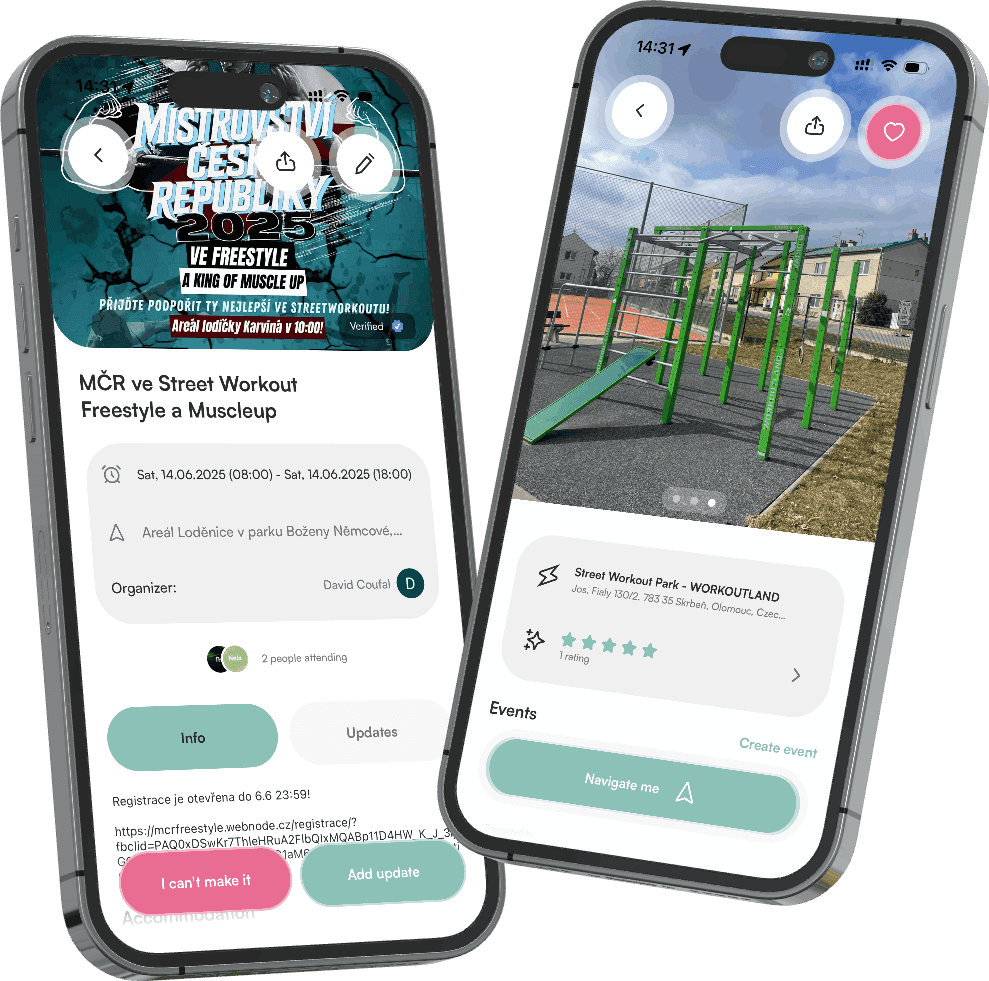
Discover a seamless way to find calisthenics spots and events near you. Explore workout locations, ongoing events, and save your favorite places.

QR code to download Caliplaces app

5.0

3K reviews on App Store and Google Play

Download app
Caliplaces mobile app preview